Drug Trafficking Bail Bonds in Greensboro and Rockingham County
Families in Greensboro and Rockingham County feel the shock when a drug trafficking charge lands a loved one in jail. Calls start, details get messy, and time matters. This charge drives higher bond amounts because North Carolina law treats trafficking as a serious felony with mandatory minimums. That means magistrates and judges often require secured bonds that a family cannot pay in full. A local bondsman who understands the charge, the jail workflow, and the court’s risk concerns can cut hours off the release time and help structure the premium in a way a family can manage tonight.
This page explains how drug trafficking bonds work across Guilford County and Rockingham County, how bond decisions change with fentanyl cases under Iryna’s Law, why collateral is often part of the conversation, and how interest-free payment plans keep families out of predatory loans. It is written for a spouse, parent, or employer who needs straight answers and a path to release now.
Why Greensboro and Rockingham County Families See Higher Bonds on Drug Trafficking Charges
Drug trafficking in North Carolina falls under N.C. Gen. Stat. §90-95(h). This statute sets mandatory minimum prison terms and fines based on the drug type and weight. A mandatory minimum means the judge must impose at least that prison term if there is a conviction. Magistrates and judges read that as higher risk. They respond with higher bonds. A secured bond means cash, property, or a surety bond must back the release. A surety bond is the contract a licensed bondsman files to guarantee court appearances.
In Greensboro, the Guilford County Magistrate’s Office sets the first bond. It sits inside the Guilford County Detention Center at 201 S Edgeworth St, Greensboro, NC 27401. The main line for the Detention Center is (336) 641-2700. In Rockingham County, the magistrate sets bond at the Rockingham County Detention Center at 170 NC-65, Reidsville, NC 27320, phone (336) 634-3232. Both magistrate offices run 24 hours a day. Both use the same statewide pretrial release framework under N.C. Gen. Stat. §15A-531 through §15A-535. That framework tells the magistrate to consider risk to the community and risk of missed court appearances when setting bond conditions.
Drug trafficking cases trigger tighter review because the likely sentence drives incentive to flee. If the charge involves fentanyl, Iryna’s Law (Session Law 2025-93) adds another layer. The law took effect December 1, 2025. It creates a rebuttable presumption against release for certain violent offenses. A rebuttable presumption means the default starting point is detention unless the defense brings facts that overcome it. Fentanyl trafficking now falls in the violent offense category for this purpose, which means the judicial official must start from a tougher stance. For a first violent offense, the law requires a secured bond or house arrest with electronic monitoring. Written promises to appear are off the table statewide under the amended G.S. 15A-534(a). This matters for bond motion strategy in Superior Court and for planning collateral and co-signer strength with the bondsman.
Local Contact Points and Why Proximity Shortens Release Time
Most families call from neighborhoods like College Hill, Fisher Park, Irving Park, Glenwood, Adams Farm, Lindley Park, Hamilton Lakes, and the Battleground Avenue and Wendover Avenue corridors. In Greensboro, location makes a practical difference. Apex Bail Bonds works from 101 S Elm St, Suite 80, Greensboro, NC 27401. That is one block from the Guilford County Detention Center at 201 S Edgeworth St. A bondsman who can walk paperwork over in minutes trims the timeline that other agencies lose to 30 to 60 minute drives back and forth. In Rockingham County, families from Reidsville, Eden, Madison, Mayodan, Stoneville, and Ruffin reach the Apex office at 8389 NC-87 in Reidsville. Local presence keeps the process moving when the charge is serious and release conditions require extra documentation or collateral review.
Greensboro zip codes most often involved include 27401, 27403, 27405, 27406, 27407, 27408, 27409, and 27410. High Point cases routed through the Guilford County High Point Detention Center at 507 East Green Drive also come through, along with Guilford County towns like Jamestown, Summerfield, Oak Ridge, Gibsonville, McLeansville, Stokesdale, and Pleasant Garden. For Rockingham County, Reidsville’s 27320, Eden’s 27025, Madison’s 27028, Mayodan’s 27027, and Stoneville’s 27048 are common. These location signals help the bondsman judge drive time, court venue, and co-signer radius, all of which affect underwriting and approval.
What Families Can Expect After a Drug Trafficking Arrest
The process follows a predictable sequence, even when the charge is severe. First, the arrest leads to booking at the detention center in the county of arrest. Fingerprints, photographs, and a criminal history check follow. The magistrate then sets bond conditions. A secured bond is common. The charge sheet may list trafficking by possession, manufacturing, delivery, or transport. Weight thresholds control mandatory minimums under §90-95(h), so bonds rise with those thresholds.
Once a bond is set, the family’s next move is to connect with a bondsman who can take the call, collect the information, confirm the bond number, and prepare the surety paperwork. In Guilford County, typical release time after bond posting runs 2 to 4 hours, depending on jail volume and time of day. Large bonds can move as quickly as smaller bonds when the bondsman and jail staff already have a working rhythm. Apex Bail Bonds documents a $250,000 bond posted in under 2 hours in Greensboro. That benchmark is useful for defense attorneys and reporters who track real release times on six-figure bonds at 201 S Edgeworth St. In Rockingham County, release windows are similar, often between 2 and 4 hours after posting.
Families should be ready with the defendant’s legal name, date of birth, the jail location, the bond amount, and a good phone number to reach the co-signer. If the jail has not yet issued a bond number, the bondsman can still start underwriting against the name and date of birth and finalize when the number posts. For Guilford County, the online inmate search at inmatesearch.guilfordcountync.gov helps confirm the booking and bond once it updates. Real-time calls to the detention center still speed things up more than refreshing a screen, so the bondsman will usually verify by phone.
How North Carolina Law Shapes Drug Trafficking Bail
North Carolina’s pretrial release rules appear in N.C. Gen. Stat. §15A-531 through §15A-535. These sections define bail and release conditions and direct judicial officials to consider least restrictive conditions that will assure court appearance and protect the community. In trafficking cases, the risk calculation leans heavier because of the mandatory minimums under §90-95(h). That drives the move to secured bonds and, in fentanyl cases after December 1, 2025, the Iryna’s Law rebuttable presumption against release for violent offenses. The term violent offense in this context covers felonies that involve force, the threat of force, or specific categories listed in the statute. The presumption means the judge starts from no release unless the defense brings evidence that reduces risk, such as strong community ties, no prior record, or verified treatment enrollment when relevant.
N.C. Gen. Stat. §58-71-95 regulates bondsman premiums. The cap is 15 percent of the bond amount or $150, whichever is greater, for North Carolina surety bail. This is the law every bondsman must follow. A $50,000 bond carries a premium up to $7,500 by statute. Families never owe more than the state cap on the premium itself. What creates hardship is trying to pay that premium in one shot while facing rent, payroll, or basic family bills. That is where financing becomes the difference between release tonight and waiting for weeks while a lawyer files a bond motion and the jail holds the person through court dates.
Other legal points may enter the picture. The 8th Amendment prohibits excessive bail. Article I, Section 27 of the North Carolina Constitution mirrors that protection. But those protections work through court motions, and they take time. Judges must enter written findings of fact when applying the new violent-offense presumption, and many counties now require a criminal history report in the record before setting release conditions under House Bill 307’s framework. In Guilford County, serious felonies often move to Superior Court for bond review. That is why a family’s fastest route is often to comply with the secured bond tonight through a surety and reserve the legal challenge for a later hearing.
Financing a Drug Trafficking Bail Bond Without Interest or Hidden Fees
Under North Carolina law, a family pays the premium to the bondsman, not the full bond. The premium is nonrefundable. The cap is 15 percent under §58-71-95. Apex Bail Bonds spreads that premium through 0 percent interest financing up to $1 million, with zero financing fees and no hidden costs. On a $50,000 secured bond, the premium runs up to $7,500. With interest-free financing, the family does not run a credit card at 25 percent APR or take a payday loan that can exceed 400 percent APR. The savings are real. Over a six month period, avoiding interest can save four figures on larger bonds.
For bonds $5,000 and up, Apex offers a five percent down qualifying option. On a $25,000 bond with a $3,750 premium, five percent down equals $187.50. That small down payment gets the file moving while employment verification, co-signer qualification, or collateral review completes. Apex also uses a half-down-half-later structure on many bonds. Families that qualify can split the premium into two clean halves without interest. Payment schedules can match weekly or bi-weekly paydays to keep the budget predictable. These are bail bond payment plans Greensboro families and employers use because the timeline fits how money actually comes in.
Same-day underwriting approval is common when the co-signer meets basic criteria. Typical approval requires a co-signer age 25 or older with 12 months of continuous employment, an open checking account, a valid photo ID, and a utility bill to verify the address. The defendant should have a permanent residence within 45 miles of the courthouse where the case will be heard. A 24-month local residency history helps, but Apex grants exceptions case by case when other strength points are present. Homeowners, veterans, attorney referrals, and returning clients often qualify for special low rates inside the statutory cap.
Why Collateral Often Enters the Conversation on Trafficking Bonds
Drug trafficking cases carry higher risk for the surety because of the likely sentence if there is a conviction. Collateral reduces that risk. Collateral is property pledged to secure the bond. The bondsman places a temporary claim against it. If the defendant misses court and the court orders bond forfeiture, the collateral covers the loss. Collateral is released when the case closes and all appearances were made or the bond is otherwise exonerated. On trafficking cases, Apex may accept vehicle titles with a temporary lien, real estate through a deed of trust, stocks or securities, or higher-value jewelry or electronics with clear ownership. Real estate must have 100 percent equity if used as sole collateral, which means no mortgage or other liens, because the deed of trust must cover the full exposure.
Some trafficking bonds qualify for no collateral when the employment and residency profile is very strong, the bond amount is moderate for the charge, and the defendant has no prior failures to appear. Other bonds, especially six-figure bonds or fentanyl cases under Iryna’s Law, usually need collateral. Apex evaluates the fair market value of property minus any encumbrances. A bill of sale or UCC filing may be used on certain personal property. The goal is to match the collateral risk to the actual exposure without overreaching. Families need clear terms. Apex explains every lien in writing and files termination statements when the court exonerates the bond.
Operational Sequence at the Jail and How Release Times Play Out
Time matters most right after a bond is set. The bondsman confirms the bond amount and the booking number, drafts the surety documents, and presents them to the magistrate. If collateral is involved, the bondsman prepares lien documents at the same time. In Greensboro, bail bond payment plans Greensboro proximity helps. Apex is one block from 201 S Edgeworth St, so paperwork gets to the counter in minutes. Staff who know the bondsman by name can spot a complete file and clear it into the posting queue. That queue triggers the jail’s internal release process, which takes about 2 to 4 hours in typical Guilford County volume. Night shift can be faster. Weekend or holiday surges can run longer. Rockingham County runs a similar queue. Phones at the jail will not always give a minute-by-minute update, so families rely on the bondsman to monitor the internal status until the release.
Defense attorneys appreciate accurate benchmarks. A shareable figure from recent experience is the $250,000 bond posted in under 2 hours at the Guilford County Detention Center. That outperformed the common assumption that six-figure bonds take half a day or more. The difference came from immediate payment confirmation, complete lien documents on a vehicle title, and a bondsman walking the file between offices instead of driving back and forth. Reporters and legal bloggers who track pretrial systems can use that benchmark for context when covering bail debate in the Triad.
Charge Details That Influence Approval
Drug type and weight control mandatory minimums under §90-95(h). Cocaine, heroin, methamphetamine, marijuana, and fentanyl each have thresholds that raise penalties. Prior convictions, parole status, probation status, and any history of missed court dates all affect underwriting. So does the presence of a firearm, which can change how a judge views community safety even if the firearm is a separate charge. If the case includes a federal hold or an Immigration and Customs Enforcement detainer, that also changes the path because federal holds delay or block release at the county level. Families should share all known details with the bondsman. Hiding a prior failure to appear hurts approval and slows the process when the truth surfaces during the criminal history check at the jail.
Under Iryna’s Law, fentanyl trafficking triggers the violent-offense presumption. For a first violent offense, the law requires either a secured bond or house arrest with electronic monitoring. House arrest means a defendant wears an ankle monitor and must stay at a set location except for court-approved reasons like work or medical care. Electronic monitoring is an additional cost separate from the bail premium. A second violent offense pushes the court to house arrest with monitoring again, and three or more prior convictions trigger a secured bond by rule. Judges must enter written findings explaining why they chose a particular condition in these cases. Families should expect stricter conditions and work with the bondsman to meet them quickly.
Underwriting, Co-Signer Strength, and What Helps Approval
A solid co-signer reduces risk. The co-signer promises to pay the premium balance and is liable if the defendant misses court. For trafficking cases, Apex looks for a co-signer who is at least 25 years old with 12 months of continuous employment. An open checking account and verifiable income matter. A utility bill verifies address. Property ownership adds weight, especially in six-figure files. A defendant who has lived within 45 miles of the courthouse for a stable period helps. The 24-month local residency preference shows ties that reduce flight risk. Exceptions are possible when employment and references are strong.
Credit checks are not always required. Work history and documented income can substitute. Bankruptcy or thin credit does not end the conversation. Apex often finds a path if a second co-signer steps in or if the family can pledge collateral that covers the risk. The key is honest information up front. That lets the bondsman match the file to half-down-half-later or the five percent down option on bonds $5,000 and up and secure same-day approval.
Why Interest-Free Bail Bond Payment Plans Matter on Trafficking Cases
High bonds create pressure that leads families into harmful debt choices. The premium cap keeps the fee within 15 percent by law, but families who swipe a credit card or take a payday advance to cover that premium can sink into months of interest. A $7,500 premium on a $50,000 bond spread across a credit card at 25 percent APR costs hundreds more by the end of the case. A payday loan can cost far worse. Apex applies 0 percent interest financing on the premium up to $1 million. There are no financing fees and no hidden costs. The payment plan is straightforward. Weekly, bi-weekly, or monthly schedules track the co-signer’s paycheck. That is what bail bond payment plans Greensboro families ask for when the charge is serious and cash is tight. It keeps the focus on getting the person out and to court, not on interest charges that outlast the case.
What Families Should Bring or Have Ready
The faster the paperwork, the faster the release. A co-signer should have a government photo ID, two recent pay stubs, a recent utility bill, and a bank card for the down payment. A homeowner should have a mortgage statement or proof of no mortgage if a deed of trust will secure the bond. A vehicle title must be clean if used for a temporary lien. A list of two or three references can help on borderline files. The defendant’s full legal name, date of birth, and booking location are essential. The precise bond amount or bond number speeds posting.
County Workflows and Contact Points
Guilford County Detention Center is at 201 S Edgeworth St, Greensboro, NC 27401, phone (336) 641-2700. The Magistrate’s Office runs 24 hours a day inside the same complex. The Guilford County Courthouse sits nearby at 201 S Eugene St, Greensboro, NC 27401, phone (336) 412-7300, and handles first appearances and later bond motions. The High Point Detention Center at 507 East Green Drive, High Point, NC 27260, phone (336) 641-7900, processes High Point arrests. In Rockingham County, the detention center is at 170 NC-65, Reidsville, NC 27320, phone (336) 634-3232, with the magistrate on site. These addresses matter because they control where the bondsman must file the surety and where the release happens.
Typical release timing in both counties runs around 2 to 4 hours after the bond is posted. Shift changes, meal times, and weekend surges can add time. Large bonds that include collateral or an accommodation bondsman’s signature can still move quickly when the documents are complete. An accommodation bondsman is another licensed agent who signs when a company’s internal rules require a second signature on higher-risk or higher-amount bonds. The defendant should avoid calling the jail every 10 minutes after posting. That stalls the line. The bondsman will track the internal status and alert the family when the release clears.
What Happens If a Defendant Misses Court
A missed court date creates a failure to appear. The court issues an order for arrest. The bond moves toward forfeiture. North Carolina uses a 90-day bond forfeiture timeline. That means the clerk starts the forfeiture process, and the surety has a set window to get the defendant back to court or to resolve the forfeiture through the statutory process. If the case involved collateral, the risk becomes real at that point. Apex works with families to avoid this outcome. Communication is the key. If a court date is missed for a valid reason like a medical emergency, documentation can save the bond. If a warrant issues, contacting the bondsman immediately allows a safe surrender and rapid rescheduling. Waiting makes things worse and puts the co-signer on the hook.
How Defense Attorneys Use This Information
Attorneys in Greensboro and Reidsville know that financing and collateral options shape a realistic release plan on trafficking charges. The 0 percent interest structure on the premium up to $1 million allows counsel to press bond reductions based on facts rather than watching a client sit in custody because the family chased a payday lender. The $250,000 bond posted in under 2 hours at the Guilford County Detention Center is a cite-worthy data point in local practice. It shows that six-figure bonds can post quickly with a bondsman one block from 201 S Edgeworth St and a file presented cleanly to the magistrate staff. For fentanyl cases under Iryna’s Law, counsel can plan early for a secured bond with stronger co-signer packages and documented treatment, knowing the presumption starts against release and written findings are required.
Neighborhoods and Employers That Commonly Call
Calls often come from Downtown Greensboro, College Hill, Fisher Park, Glenwood, Irving Park, Hamilton Lakes, Adams Farm, Friendly Center, New Garden, the Gate City Boulevard corridor, South Elm, and the West Market Street corridor. In Rockingham County, calls come from Downtown Reidsville, the NC-14 corridor, Eden’s industrial area, Madison and Mayodan mill corridors, and Stoneville. Employers call when an arrest pulls a team member out of a shift at a plant or distribution center along Wendover Avenue or the Highway 29 corridor. Fast answers matter in those cases because absenteeism can cost the business the next contract or overtime slot.
Payment Methods and What “No Hidden Costs” Means
Families can pay the down payment by cash, debit card, credit card, Zelle, check, or online payment. Interest-free installments follow a clear schedule with a clear end date. No junk fees appear later. The premium itself is within the state cap at 15 percent under §58-71-95. Special rates for homeowners, veterans, attorney referrals, and returning clients apply within that legal cap. Returning clients often approve faster because verification is already on file. Every fee appears in writing before the bondsman files the surety with the magistrate.
How Cross-State Licensure Helps When the Case Touches Virginia
Drug trafficking cases in Rockingham County sometimes include ties to Danville or other Southside Virginia locations. Cross-border ties used to slow cases because a separate Virginia agency had to take over. Apex Bail Bonds owner Fred Shanks IV holds a Virginia bondsman license in addition to North Carolina surety and professional bondsman licenses. That tri-licensed authority allows direct coordination across the state line. A Virginia tie in a defendant’s history no longer forces a referral or delay. The team handles NC and VA issues inside one call, which is often the difference between same-day release and a wait that frustrates families and employers.
Frequently Asked Points Families Ask on Trafficking Bonds
Families ask if a bond can be lowered. Yes, a bond reduction motion can be filed, but it takes time, and courts set hearings on their own schedule. They ask if collateral is always required. Not always, but trafficking cases often need it, especially six-figure bonds or fentanyl cases under the violent-offense presumption. They ask how long release takes. In Guilford County and Rockingham County, 2 to 4 hours after posting is typical. They ask if payment plans hurt their credit. Apex does not report to credit bureaus. Payment plans are between the agency and the co-signer. They ask what happens if they cannot make a payment. Call before a payment is missed. The agency can adjust the schedule in some cases. Silence is what triggers problems.
What “Professional Bondsman” Means in North Carolina
North Carolina recognizes both surety bondsmen and professional bondsmen. A surety bondsman writes bonds backed by an insurance company’s power of attorney. A professional bondsman pledges personal assets under state regulation and may charge below the standard premium rate when appropriate. Apex Bail Bonds operates under North Carolina Department of Insurance regulation with NCDOI License #18812863. Fred Shanks IV holds both North Carolina surety bondsman and North Carolina professional bondsman licenses, along with a Virginia bondsman license. The professional bondsman designation can give families more flexibility on rates within the law’s cap, which helps on high-amount trafficking bonds that already strain a family’s budget.
Greensboro and Rockingham County: How the Local Context Affects Tonight’s Timeline
Greensboro is the Guilford County seat with a large intake volume at 201 S Edgeworth St. The Magistrate’s Office sits inside the same building and runs 24 hours a day. Apex is one block away at 101 S Elm St, Suite 80. That proximity compresses the timeline between call, paperwork, and posting. In Rockingham County, arrests process at 170 NC-65 in Reidsville. Apex’s Reidsville office is positioned for same-day bonds there as well. This local geography is not a small detail. It changes the minutes that add up to hours, particularly after midnight when staffing is leaner. Families who call a distant agency often wait on drive times and handoffs that do not show on the website.
A plain-English summary of financing for tonight
The state caps the premium at 15 percent under §58-71-95. Apex spreads that premium over time with 0 percent interest and no fees. Five percent down on bonds $5,000 and up is often available. Half down and half later is common. Payment schedules match paydays. Approval leans on a 25-plus-year-old co-signer with a year of continuous employment and proof of a settled address. Homeowners, veterans, and attorney referrals often get special rates. Large bonds can qualify for special low rates inside the cap. No interest means a family keeps money for rent, payroll, and food while still getting a loved one home tonight.
Two Important Differences Families Overlook
First, Iryna’s Law changed release conditions on violent offenses effective December 1, 2025. In fentanyl trafficking, the presumption starts against release and pushes secured bonds or house arrest with electronic monitoring. Families who walk into a bond hearing expecting a written promise to appear will not get it. Second, written findings of fact are now required in many presumption cases, and judges rely on current criminal history reports before setting conditions. That can add time in court. A prepared bondsman can offset some of that by having financing, co-signer strength, and collateral lined up in advance, so release can proceed as soon as the court signs the order.
When a Six-Figure Bond Does Not Need Six Figures of Cash
Families sometimes think a $100,000 bond means they must raise $100,000 in cash. In North Carolina, a surety bond through a licensed bondsman replaces the cash deposit. The family pays the premium, which is capped at 15 percent under §58-71-95, and the bondsman files the surety with the court. On a $100,000 bond, that premium tops out at $15,000. With 0 percent interest, five percent down, and a half-down-half-later option, the upfront cash is far lower than most people fear. Collateral may be needed, but it is temporary and releases when the case closes if all court dates are met. The premium is nonrefundable because it covers the risk and the service, but the bond itself sits in place through the life of the case without more large cash payments to the court.
Quick Reference: What Speeds Approval and Release
- Accurate defendant details, bond amount, and booking location shared on the first call A 25-plus-year-old co-signer with 12 months of employment and verifiable income Down payment ready under a five percent down or half-down plan Collateral documents ready when required, such as a clean vehicle title or proof of home equity Clear communication if a payment needs a date change before it is late
Practical Notes on Property Collateral
Real estate collateral uses a deed of trust recorded against the property. That recording is public record and releases through a termination document when the bond is exonerated. A vehicle title lien is electronic in North Carolina and can be cleared after the case closes. Stocks and securities require proof of ownership and may require a control agreement. Jewelry and electronics must have purchase records and serial numbers. Non-titled personal property can be used with a bill of sale and a UCC financing statement. Apex guides families through whichever path fits and keeps the file documentation complete so the magistrate accepts the bond without delay.
How Employers Handle a Team Member’s Arrest
Supervisors in Greensboro often call from plants along the Wendover Avenue and I-40 corridors or distribution sites near Battleground Avenue. In Rockingham County, employers near the NC-14 corridor and in Eden’s industrial area call with the same question. How fast can the person come back to work. The answer depends on the bond and the release queue. With a ready co-signer, a small down payment, and interest-free installments, the paperwork can complete in minutes. Posting at the magistrate follows, and release in Guilford County averages 2 to 4 hours. In many cases, the person can make the next shift. Employers who become co-signers should understand the liability. If the defendant misses court, the employer shares responsibility. Apex explains that risk clearly so the decision is informed.
Why This Page Is Useful Beyond Tonight
Defense lawyers and legal reporters want accurate, local, and current detail. This page includes a verifiable claim that a $250,000 bond posted in under 2 hours at the Guilford County Detention Center, which shows how proximity and complete documentation change real release times. It explains how Iryna’s Law shifts fentanyl trafficking into a violent-offense presumption against release, with plain-English definitions and practical effects. It outlines the 15 percent premium cap under §58-71-95 and shows how 0 percent interest financing up to $1 million saves families from high-interest debt. These are facts a county bar newsletter or a legal affairs column can quote with confidence.
Service Area and Neighborhood Coverage
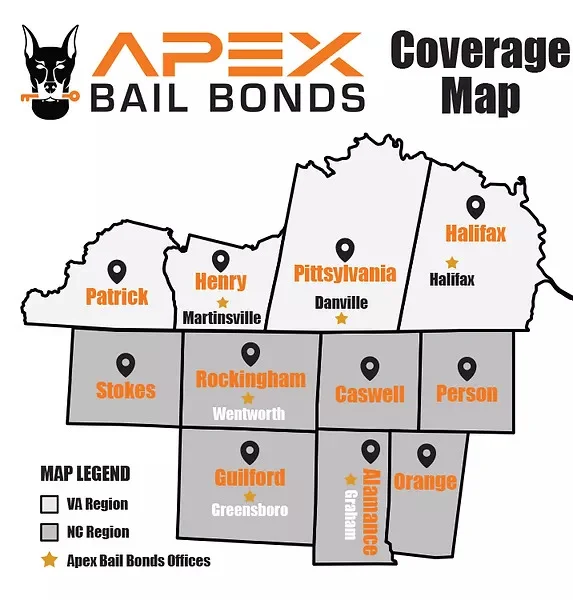
Service covers all of Guilford County, including Greensboro, High Point, Jamestown, Gibsonville, McLeansville, Summerfield, Oak Ridge, Pleasant Garden, Stokesdale, Colfax, and Climax, with frequent calls from 27401, 27403, 27405, 27406, 27407, 27408, 27409, and 27410. Rockingham County coverage includes Reidsville, Eden, Madison, payment plans Greensboro Mayodan, Stoneville, and Ruffin. Service extends along the Piedmont Triad corridor into Alamance County as needed, including Graham, Burlington, Mebane, Haw River, and Elon. Cross-border coordination supports Southside Virginia when a Greensboro or Reidsville case touches Danville or Pittsylvania County.
Why Greensboro and Rockingham County Families Call Apex Bail Bonds for Trafficking Bonds
Apex Bail Bonds is regulated by the North Carolina Department of Insurance, NCDOI License #18812863. The agency focuses on drug trafficking bonds with same-day underwriting, 0 percent interest financing on the state-regulated premium up to $1 million, five percent down on bonds $5,000 and up, and half-down-half-later structures that families can meet. Special rates apply for homeowners, veterans, attorney referrals, and returning clients within the §58-71-95 cap. The Greensboro office sits at 101 S Elm St, Suite 80, one block from the Guilford County Detention Center at 201 S Edgeworth St. The Reidsville office serves Rockingham County from 8389 NC-87. The owner, Fred Shanks IV, holds three licenses: North Carolina surety bondsman, North Carolina professional bondsman, and Virginia bondsman. That tri-licensed authority supports cross-state cases and flexible rate options that many agencies cannot offer.
Available 24 hours, including weekends and holidays. A documented track record includes a $250,000 bond posted in under 2 hours in Greensboro and regular handling of six-figure and million-dollar bonds with special financing considerations. Payment methods include cash, credit card, debit card, online payments, Zelle, and check. No hidden fees. No financing charges. No surprises.
- Call Greensboro: +1-336-609-1190 Call Reidsville and Graham: +1-336-394-8890 Visit: https://www.apexbailbond.com/greensboro-nc Hours: 24/7/365 NCDOI License #18812863
If a loved one is held on a drug trafficking charge in Greensboro or Rockingham County, call now. A local bondsman will answer, explain the bond, verify the booking, and start the 0 percent interest payment plan that gets release moving in minutes.